
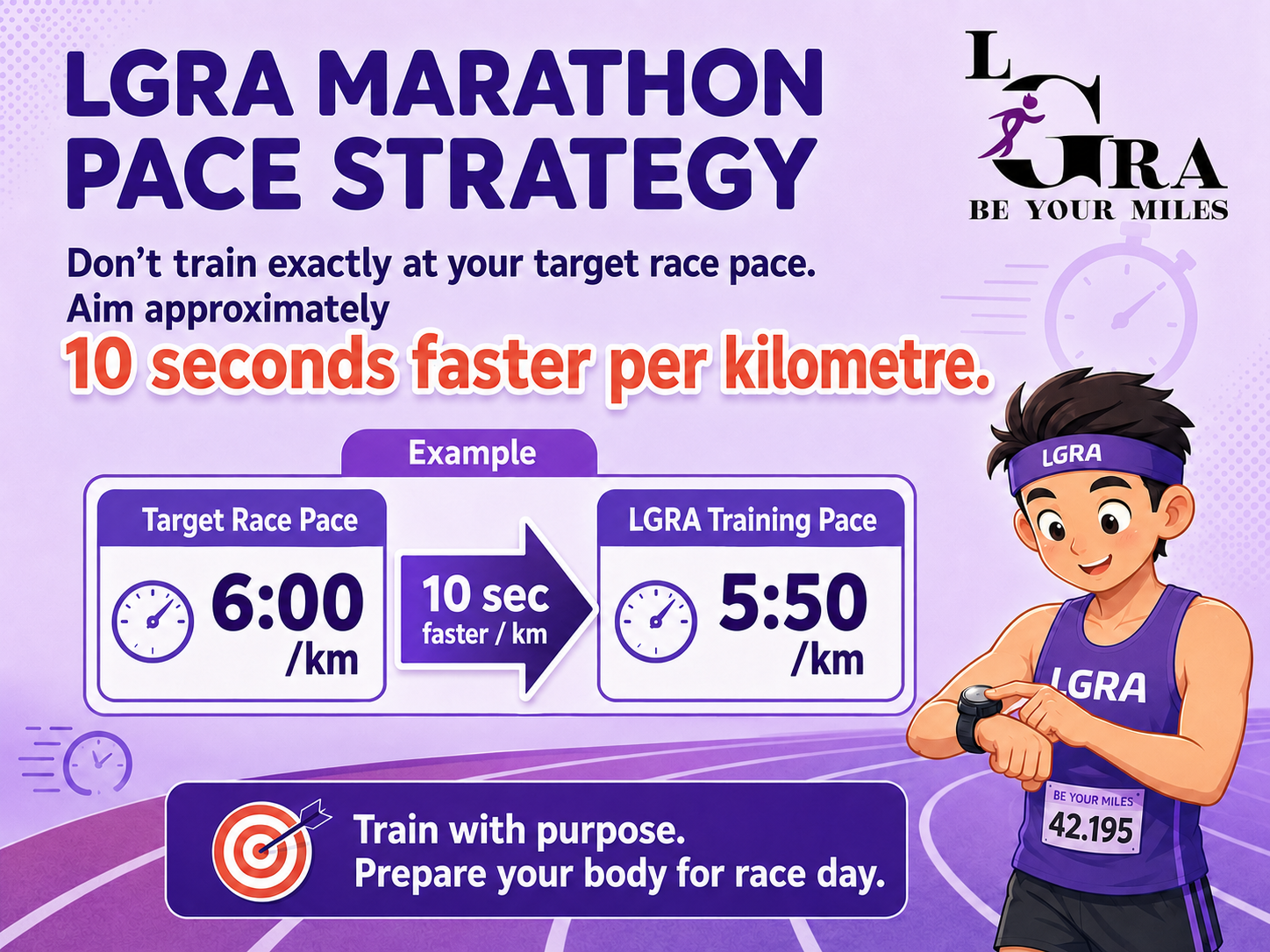
Can We Use Our Target Race Pace in Training?
Yes—but not for every training session.
Your target race pace is useful for :
Marathon race-pace training
Controlled tempo sessions
Race preparation workouts
Practising pacing and fuelling
However, easy runs, recovery runs and most long runs should usually be slower. Running every session at race pace may cause excessive fatigue and increase injury risk.
How to Calculate Marathon Race Pace :
Use this formula:
Target finishing time ÷ 42.195 km = average pace per kilometre
Example: 6-Hour Full Marathon
6 hours ÷ 42.195 km = approximately 8:32/km
Therefore:
Target marathon pace: 8:32/km
LGRA suggested training pace: 8:22/km
This is 10 seconds faster per kilometre
Standard Race Pace vs LGRA Suggested Pace

The paces are rounded to the nearest second.
Why Does LGRA Suggest 10 Seconds Faster?
Training slightly faster than target pace may help runners:
Build a small pace buffer
Make race pace feel more manageable
Improve running efficiency
Prepare for hills and crowded race sections
Manage slower water-station stops
Develop confidence before race day
But this pace should only be used during suitable, controlled workouts.
Example for a 6-Hour Marathon Target
The runner's official target pace is 8:32/km.
A race-specific workout may be:
2 km easy warm-up
3–5 km at 8:22–8:32/km
1–2 km easy cool-down
As fitness improves, the race-pace distance can gradually become longer.
The runner should still complete easy and recovery runs at a comfortable conversational effort—not automatically at 8:22/km.
Should Every Runner Use 10 Seconds Faster?
Not automatically.
The suitable pace also depends on:
Current fitness level
Training experience
Heart-rate response
Running technique
Weather and humidity
Route elevation
Injury history
Recovery condition
Run-walk strategy
For beginners, completing the distance consistently may be more important than
forcing a faster pace.
LGRA Coaching Message
Your target race pace is a guide—not the pace for every run.
LGRA may recommend training approximately 10 seconds faster per kilometre during
selected race-specific sessions. Easy days should remain easy, while harder sessions must match
the runner's current ability.
Different sessions require different paces. Train with purpose, not with one speed every day.


