
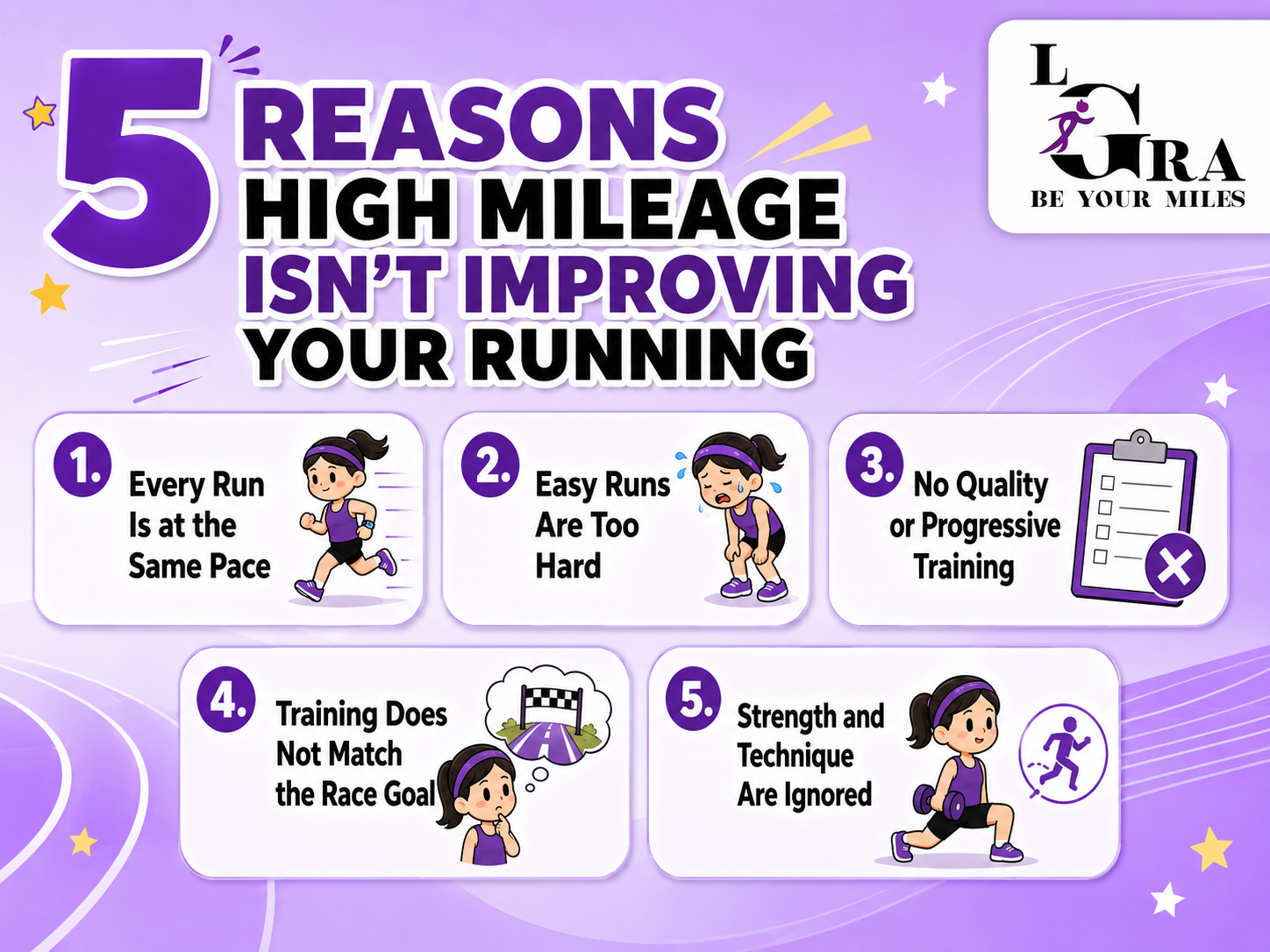
Why Am I Not Improving Despite High Running
Mileage?
Running more kilometres can improve endurance—but
high mileage alone does not guarantee better performance.
If your timing is not improving, the problem may be the structure, quality and recovery
behind your mileage.
1. Every Run Is at the Same Pace
Running at the same moderate pace every day may be:
Too fast for recovery
Too slow for speed development
Not specific enough for your race goal
A balanced programme may include:
Easy runs
Long runs
Tempo or threshold training
Intervals
Race-pace sessions
Recovery runs
Research suggests endurance athletes generally benefit from completing most training
at low intensity, combined with a smaller amount of harder work.
2. Easy Runs Are Too Hard
When easy runs are too fast:
Fatigue accumulates
Quality workouts become weaker
Heart rate may remain high
Legs constantly feel heavy
Injury risk may increase
Easy running should feel relaxed, conversational and controlled.
3. No Quality or Progressive Training
Mileage builds endurance, but runners also need suitable training to improve:
Speed
Running economy
Threshold ability
Race-pace control
Strength under fatigue
Repeating the same distance, pace and workout every week may eventually lead to
a plateau.
Progress gradually by adjusting:
Distance
Intensity
Repetitions
Recovery time
Long-run structure
Race-specific training
4. Training Does Not Match the Race Goal
Different races require different preparation.
A 5 km runner may need more:
Speed development
Faster intervals
Running economy work
A marathon runner may need more:
Long-run progression
Marathon-pace practice
Fuelling training
Muscular endurance
More kilometres are not always useful if they do not support your target race.
5. Strength and Technique Are Ignored
Poor technique or weakness can waste energy through:
Overstriding
Unstable landing
Weak glutes
Poor ankle control
Excessive body rotation
Technique breakdown when tired
Strength training can improve running economy and performance.
Read the strength-training research
Important areas include:
Glutes and hips
Quadriceps and hamstrings
Calves and ankles
Core and lower back
Single-leg stability
6. Insufficient Recovery and Nutrition
Improvement happens when the body recovers from training.
Recovery may be affected by:
Poor or inconsistent sleep
Inadequate carbohydrates and protein
Dehydration
Work or emotional stress
Too many hard sessions
No recovery days or lighter weeks
High mileage without enough food can also reduce performance, recovery and health.
Read the IOC statement on low energy availability
A Simple Example
Runner A: 60 km per Week
Most runs are moderately hard
No strength training
Poor sleep
No clear quality session
Constantly heavy legs
Possible result: High fatigue with little improvement.
Runner B: 40 km per Week
Easy runs are properly controlled
One suitable quality workout
One progressive long run
Two short strength sessions
Better sleep and fuelling
Possible result: Better-quality training and more consistent progress.
This does not mean 40 km is always better than 60 km.
It means your body must be able to use, recover from and adapt to the mileage.
How to Make Your Mileage More Effective
Give every session a purpose
Keep easy runs genuinely easy
Include suitable quality training
Add strength and technique work
Increase mileage gradually
Use race-specific workouts
Schedule recovery days
Eat and sleep according to your training load
Adjust the programme when your body is not responding
LGRA Coaching Message
High mileage is helpful only when it is suitable for the runner.
At LGRA, we analyse more than weekly distance.
We also consider pace, heart rate, technique, strength, recovery and race requirements.
Don't run more simply to train harder.
Train with purpose and allow every kilometre to contribute to your goal.
Quality + structure + recovery + consistency create improvement—not mileage alone.


