
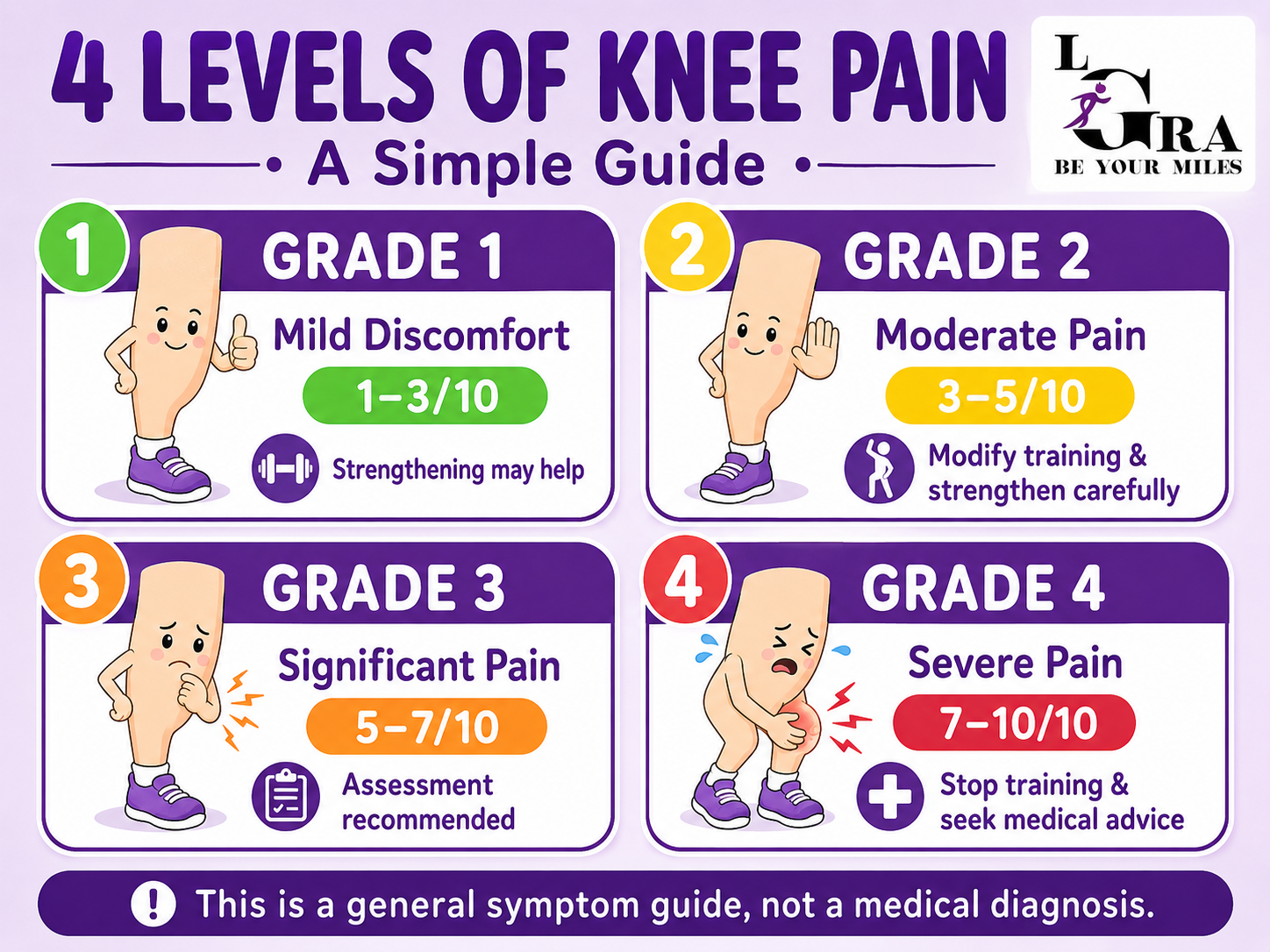
Knee Pain Grades:
Can Strengthening and Stretching Help?
Knee pain does not always mean the knee is permanently damaged.
For knee osteoarthritis, doctors commonly use the Kellgren–Lawrence scale from Grade 0 to
Grade 4, based on an X-ray. However, the X-ray grade and pain level do not always match.
Grade 0 — No Osteoarthritis
No visible joint damage
Pain may come from weakness, stiffness, overuse or poor movement
Excellent potential for improvement
Focus on technique, strength, mobility and load management
Grade 1 — Very Early Changes
Possible small bone spurs
Little or no joint-space narrowing
Occasional pain or stiffness may occur
Very good potential to control symptoms
Consistent exercise may help prevent further loss of function
Grade 2 — Mild Osteoarthritis
Definite bone spurs
Possible mild narrowing of the joint space
Pain may appear during stairs, squats or longer activities
Good potential to reduce pain and improve function
A structured strength programme is strongly recommended
Grade 3 — Moderate Osteoarthritis
Clear joint-space narrowing
Multiple bone spurs
More frequent pain, swelling or stiffness
Strength and mobility training can still provide meaningful improvement
Training should be personalised and professionally supervised
Running or jumping may need to be temporarily reduced or modified
Grade 4 — Severe Osteoarthritis
Severe loss of joint space
Significant cartilage and bone changes
Pain may affect walking and daily activities
Exercise can still improve strength, mobility and quality of life
However, it cannot reverse severe structural damage
Medical treatment or joint-replacement assessment may be required
Which Grade Still Has a Chance to Improve?
Every grade may gain benefits from suitable exercise.
Grades 0–2: Best opportunity to control symptoms and restore function
Grade 3: Pain and movement can still improve with supervised training
Grade 4: Exercise remains helpful, but medical support may also be necessary
"Recovery" does not always mean rebuilding lost cartilage. It may mean:
Less pain and stiffness
Better walking and stair movement
Stronger support around the knee
Improved balance and confidence
Returning to suitable daily activities
Delaying or avoiding further functional decline
What Should Training Include?
Quadriceps strengthening
Glute and hip strengthening
Hamstring and calf conditioning
Ankle stability
Balance and movement control
Gentle knee mobility
Suitable stretching for tight muscles
Low-impact aerobic activity
Gradual progression of training load
Strengthening is the main component.
Stretching can improve stiffness and movement, but stretching alone is normally insufficient.
Exercise is recommended for improving pain and function in knee osteoarthritis.
Programmes commonly include strengthening, range-of-motion and aerobic activities.
AAOS guidance on knee arthritis, AAOS arthritis exercise guidance
LGRA Coaching Message
Do not wait until your knee reaches Grade 4 before taking action.
Early and consistent strengthening gives you a better opportunity to maintain movement,
manage pain and protect your independence.
Even at an advanced stage, it is not “too late” to become stronger—but the programme must
match your condition.
This grading system applies specifically to osteoarthritis seen on X-rays, not every cause of
knee pain. Seek medical assessment for major swelling, locking, giving way, severe night pain,
inability to bear weight or pain following an injury.


