
What Is a Runner's Metabolism?
Metabolism is the process your body uses to convert food and stored fuel into energy.
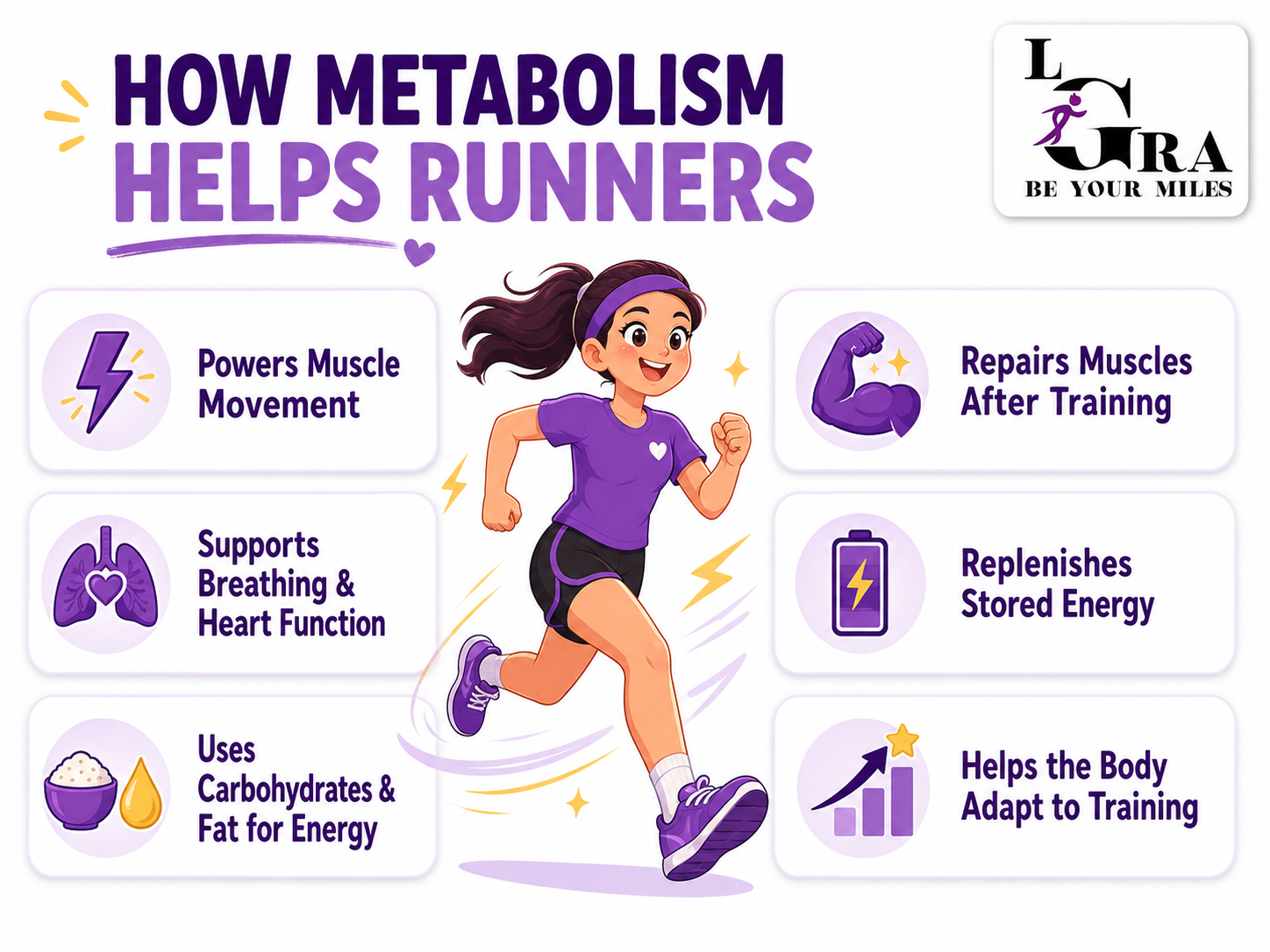
For runners, metabolism helps the body:
Power muscle movement
Maintain breathing and heart function
Use carbohydrates and fat during exercise
Repair muscles after training
Replenish stored energy
Adapt to training
In simple words:
Metabolism determines how your body produces and uses energy while
running and recovering.
What Fuels Do Runners Use?
The body mainly uses two fuels during running:
1. Carbohydrates
Carbohydrates are stored as glycogen in the muscles and liver.
They are especially important during:
Fast running
Intervals
Tempo and threshold sessions
Hill repetitions
Racing
High-intensity exercise
Carbohydrates can supply energy quickly, but the body's glycogen storage is limited.
2. Fat
The body has a much larger supply of stored fat.
Fat contributes more during:
Easy running
Lower-intensity exercise
Long, steady sessions
Recovery activities
However, fat produces energy more slowly.
As running intensity increases, the body generally depends more heavily on carbohydrates.
Research on fuel metabolism during endurance exercise
How Does Training Affect Metabolism?
Consistent endurance training can make the body better at producing and using energy.
Training may improve the runner's ability to:
Use oxygen efficiently
Produce energy inside the muscles
Use more fat at suitable intensities
Preserve limited glycogen during longer runs
Clear and reuse lactate
Maintain pace for a longer period
Recover between harder efforts
This is one reason why a trained runner may hold the same pace with a lower effort
than a beginner.
How Different Workouts Train Metabolism
Easy Runs
Easy runs develop the aerobic system.
They help the body:
Use oxygen more efficiently
Improve fat utilisation
Build endurance
Recover from harder sessions
Long Runs
Long runs teach the body to produce energy over an extended period.
They may improve:
Fatigue resistance
Glycogen management
Fat utilisation
Muscular endurance
Fuelling tolerance
Tempo and Threshold Training
These sessions help the runner maintain a faster pace before fatigue and lactate
accumulate too quickly.
They improve the ability to:
Produce energy at a higher intensity
Manage lactate
Sustain a comfortably hard pace
Maintain race effort for longer
Interval Training
Intervals place a greater demand on carbohydrate metabolism and the cardiovascular system.
They may improve:
Speed
Oxygen uptake
High-intensity energy production
Recovery between fast efforts
Running economy
Strength Training
Strength training supports metabolism indirectly by improving:
Muscle strength
Running economy
Stability
Force production
Resistance to fatigue
A more economical runner uses less energy to maintain a given pace.
A Simple Example
Two runners run at pace 6:00/km.
Runner A
Heart rate: 175 bpm
Breathing heavily
Depends strongly on carbohydrates
Cannot maintain the pace for long
Runner B
Heart rate: 150 bpm
Breathing remains controlled
Uses the aerobic system more efficiently
Can maintain the pace comfortably
The pace is the same, but their metabolic demands are different because of their fitness,
technique and training background.
Does a Faster Metabolism Mean Better Running?
Not necessarily.
A “fast metabolism” is commonly associated with burning more calories at rest.
However, running performance depends more on metabolic efficiency and flexibility.
A well-trained runner should be able to:
Use fat effectively during easier running
Use carbohydrates effectively during faster running
change between fuels according to intensity
preserve energy during long-distance events
recover and replenish energy after training
This ability is sometimes called metabolic flexibility.
Nutrition Must Support Training
Training adaptation requires enough fuel.
Runners who consistently eat too little may experience:
Low energy
Heavy legs
Poor recovery
Reduced training quality
Loss of strength
Frequent illness or injury
Declining performance
Carbohydrates support running performance, while protein supports muscle repair and adaptation. Fat also supports normal health and provides energy.
Training the body to use more fat does not mean runners should completely avoid carbohydrates.
High-intensity and race-performance demands still rely heavily on carbohydrates.
LGRA Coaching Message
Different workouts develop different parts of a runner's metabolism.
At LGRA, we do not use only mileage to evaluate training. We also consider:
Running intensity
Heart-rate response
Pace and perceived effort
Workout duration
Fuelling
Recovery
Running technique
The runner's target event
Easy runs build the aerobic foundation. Threshold sessions improve sustained effort. Intervals develop higher-intensity performance, while long runs improve endurance and fuel management.
Train every energy system with the correct purpose. Fuel your body properly and allow it to adapt.


