
How Are Calories Burned During Running
Calculated?
The calories shown on your watch are only an estimate. They are calculated using your personal information together with your workout data.
Basic Running Calculation
A simple calculation for running is:
Calories burned ≈ body weight (kg) × distance (km)
Example
A 60 kg runner completes 5 km:
60 kg × 5 km = approximately 300 kcal
This is a general estimate. The actual result can be higher or lower.
Key Factors Affecting Calories Burned
1. Body Weight
A heavier runner generally uses more energy
A lighter runner generally uses less energy
Your watch profile should contain your updated weight
2. Distance and Workout Duration
A longer distance normally burns more calories
A longer workout increases total energy expenditure
Distance is one of the main factors for running
3. Running Speed
Faster running burns more calories per minute
However, covering the same distance faster
may not greatly increase the total caloriesSprinting and intervals may create
greater energy demand than steady running
4. Road Surface and Gradient
Running requires more energy on:
Uphill routes
Trails
Sand
Grass
Uneven or soft surfaces
A flat and firm road is normally more economical.
Gradient usually makes a bigger difference
than the road material alone.
5. Heart Rate During Exercise
A higher heart rate may indicate:
Greater exercise intensity
Higher oxygen and energy demand
Increased effort during the workout
However, heart rate can also increase because of:
Hot and humid weather
Dehydration
Stress
Caffeine
Poor sleep
Fatigue or illness
Therefore, a higher heart rate does not always mean
that significantly more calories were burned.
6. Individual Fitness and Running Economy
Two runners completing the same workout
may not burn exactly the same calories.
The result can also be affected by:
Age
Sex
Fitness level
Running technique
Muscle mass
Running economy
Individual metabolism
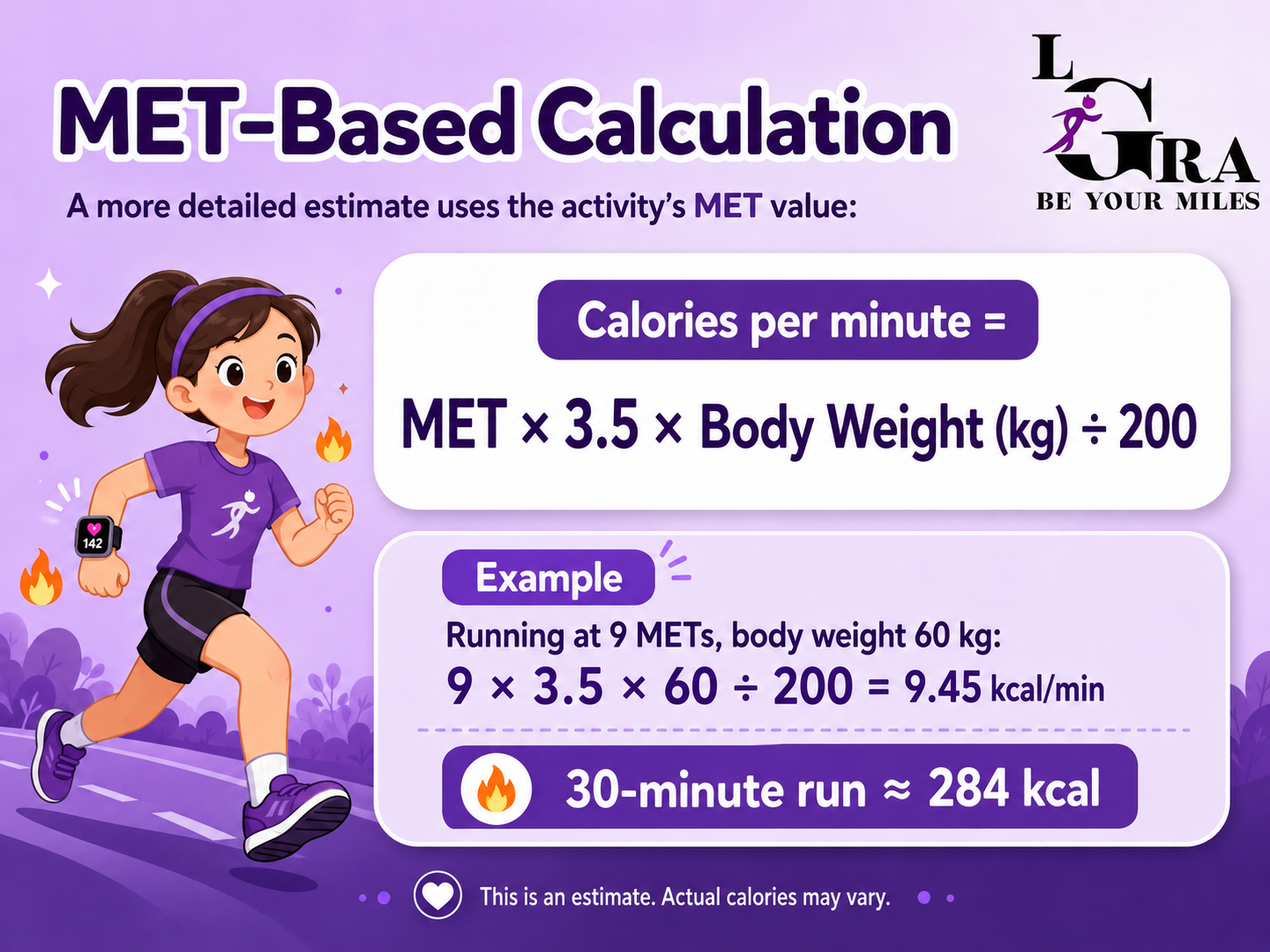
MET-Based Calculation
A more detailed estimation uses the activity's MET value:
Calories per minute =
MET × 3.5 × body weight (kg) ÷ 200
Example
A 60 kg runner performs an activity rated at 8 METs
for 30 minutes:
8 × 3.5 × 60 ÷ 200 × 30
= approximately 252 kcal
Different running speeds and activities
are assigned different MET values.
Can We Trust Our Sports Watch?
A sports watch may use:
Age, sex, height and weight
Workout duration
Speed and distance
Heart-rate data
Activity type
Fitness information
The number is useful for monitoring trends, but it should not be treated as an
exact measurement.
Make sure your personal profile and heart-rate settings are updated for a more
reasonable estimate.
Suggested Calculation Websites
Compendium of Physical Activities
Provides research-based MET values for different activities.ACE Physical Activity Calorie Counter
Estimates calories using activity type, duration and body weight.Garmin: Understanding Calorie Tracking
Explains how Garmin uses personal and activity information.
The updated 2024 Adult Compendium contains energy-cost information for more than 1,100 physical activities.
LGRA Coaching Message
Calories burned are affected by more than speed and heart rate alone.
Body weight and distance provide a basic estimate, while speed, duration, gradient, surface,
heart rate and individual running economy refine the calculation.
Use the calorie number as a helpful guide—not an exact answer.


