
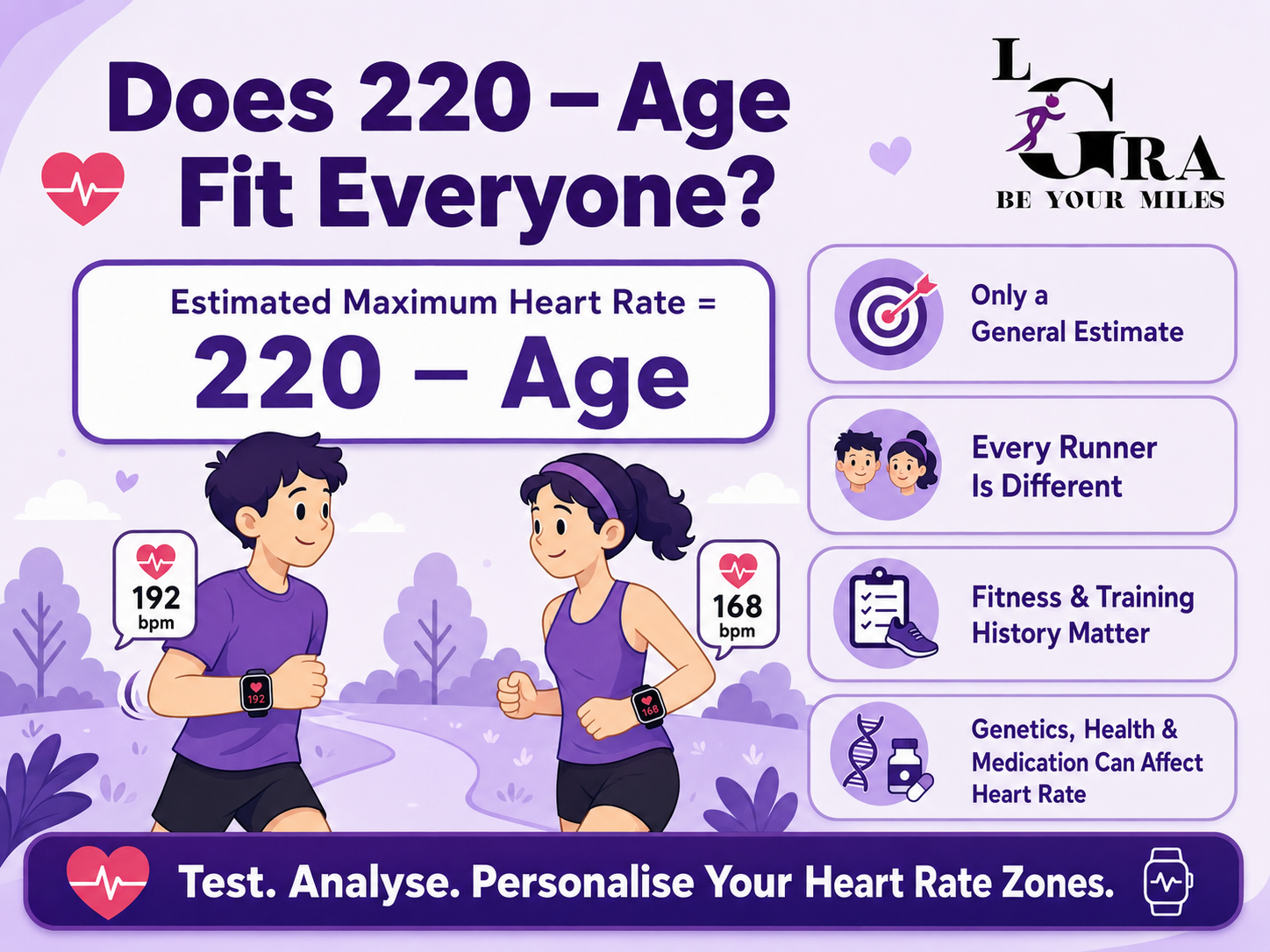
Heart Rate Zones: Why One Formula
Does Not Fit Every Runner
Many runners use general heart-rate zones from a watch or the formula:
Maximum heart rate = 220 − age
This can provide a basic estimate, but it may not accurately represent an individual
runner.
Two runners of the same age can have very different:
Maximum heart rates
Resting heart rates
Lactate thresholds
Training backgrounds
Responses to heat and humidity
Recovery levels
Running efficiency
Research has found that age-based maximum heart-rate formulas can have considerable
individual error.
Study on age-predicted maximum heart rate
The LGRA Approach
At LGRA, we do not focus only on general heart-rate zones.
We study how each runner's heart rate responds during different types of workouts, including:
Easy runs
Long runs
Steady runs
Tempo and threshold sessions
Interval training
Hill workouts
Race-pace sessions
Recovery runs
We analyse the relationship between:
Heart rate
Running pace
Breathing
Perceived effort
Recovery between repetitions
Heart-rate changes during longer runs
Training conditions and temperature
From these results, we can build a more personalised and practical training range for the runner.
Why Use Different Workouts?
One short test cannot always show the complete picture.
Different sessions help us understand different areas:
Easy runs show whether the runner can stay relaxed and controlled.
Long runs show endurance and heart-rate drift over time.
Tempo runs help identify a sustainable, comfortably hard effort.
Intervals show the response to high intensity and recovery.
Hills reveal how the heart responds to increased muscular demand.
Race-pace sessions connect heart rate with actual performance goals.
Heart-rate zones based around physiological thresholds can provide more individualised
information than zones based only on age.
Research on threshold-based training zones
A Simple Example
Imagine two runners who are both 35 years old.
Using the general formula:
220 − 35 = 185 bpm
Both runners may receive the same estimated maximum heart rate—but their actual
responses can be very different.
Runner A
Easy running: 135–145 bpm
Controlled tempo: 160–168 bpm
Hard intervals: 175–185 bpm
Recovers quickly between repetitions
Runner B
Easy running: 145–155 bpm
Controlled tempo: 170–178 bpm
Hard intervals: 185–195 bpm
Maintains a naturally higher heart rate
This does not automatically mean Runner B is less fit or training too hard.
Their individual heart-rate profile may simply be higher.
If both runners follow the same general chart, one may run too slowly while
the other may train too hard.
Heart Rate Can Change Daily
Heart rate is useful, but it should not be judged alone.
It may be higher than usual because of:
Hot and humid weather
Dehydration
Poor sleep
Stress
Caffeine
Illness
Accumulated fatigue
A difficult previous workout
It may also rise gradually during a long run even when the pace remains unchanged.
This is known as cardiovascular drift.
Therefore, runners should also consider:
How the breathing feels
Whether conversation is still possible
Rate of perceived exertion
Pace and running form
Overall recovery condition
How LGRA Builds Your Heart-Rate Zones
Our process is simple:
Collect heart-rate data from different workouts.
Compare heart rate with pace and perceived effort.
Identify sustainable and high-intensity ranges.
Review recovery between repetitions.
Observe changes across several weeks.
Adjust the zones as fitness improves.
The purpose is not to chase a perfect number.
The purpose is to create training zones that are:
More personalised
Easier to follow
Suitable for current fitness
Connected to the runner's goal
Adjustable as the runner improves
LGRA Coaching Message
Your heart-rate zone should describe your body—not only your age.
At LGRA, we study the runner's response across different workouts before deciding the
most suitable training intensity.
Heart rate is an important guide, but it works best together with pace, breathing,
perceived effort and coaching observation.
Test individually. Analyse carefully.
Train within the right range and progress smartly.
Runners with chest pain, fainting, unusual breathlessness, known heart conditions or
unexplained heart-rate changes should seek medical advice before performing
maximum-effort testing.


